


From Campaigns to Content Engines: How Financial Services Brands Are Turning Trust Into Revenue
Magnet POV The firms winning in financial services are not the ones producing the most content; they are the ones that have built the systems, voices, and measurement layers that turn content into compounding authority. This piece maps the three patterns that separate those firms from the rest, and points toward what becomes possible when trust is not just the product you sell, but the strategy you build around.

Here’s a number worth sitting with: $10 billion.
That’s the estimated market value Forrester says enterprise brands lost last year from ungoverned AI adoption and fragmented content strategies. Ten billion dollars. Not from bad products. Not from failed compliance. From content that no one coordinated, that pointed in too many directions, that built noise instead of trust.
And yet, budgets are up. Teams are larger. AI tools have made it faster than ever to produce more, across more channels, with less friction. So what’s happening?
According to 6sense, 86% of B2B purchases stall mid-cycle, not because buyers can’t find information, but because they lose confidence in the vendor’s story. The content was there. The conviction wasn’t.
This isn’t a volume problem. It never was. And in financial services, where trust is quite literally the product, it’s one of the most expensive problems a marketing team can have. We see it in three patterns, over and over again.
The firms closing that gap share something in common: they’ve stopped running campaigns and started building content engines, always-on, strategy-led systems that compound authority over time. Here’s what separates them from the rest.
Pattern 1: They’ve Unifed the Executive Voice
Ask most financial services firms who their authoritative external voice is, and the honest answer is: it depends on the day.
There might be a few LinkedIn posts from one or two senior leaders. There are press releases. There are regulatory filings. But there’s rarely a coherent narrative running through the executive bench, one that compounds over time and gives buyers a clear sense of what the firm actually stands for.
Each business unit publishes independently. Each leader speaks to their own slice of the audience. The firm’s most credible voices, the people with real market expertise and real institutional relationships, stay mostly invisible to the buyers, partners, and advisors they’re trying to reach.
Equitable is a strong example of what this looks like in practice. Whether through boosting the accomplishments of their teams, highlighting the capabilities of their products, or sharing their insights into strategy and leadership, Equitable has built executive messaging into their communications strategy, ensuring a cohesive, credible, and compounding narrative.
Pattern 2: They’ve Made Compliance a Collaborator, Not a Gate
Here’s the thing about compliance: it’s real, it matters, and it’s not going away. Anyone who tells you otherwise hasn’t worked in financial services.
But somewhere along the way, many content teams stopped working within compliance constraints and began using them as a reason not to try. The output is content that is technically airtight and completely forgettable. Tightly disclaimed. Thoroughly hedged. Stripped of anything that sounds like a human being actually has an opinion.
The goal was risk management. The result was irrelevance.
Leading firms stand apart from their competitors by building a compliance-integrated workflow. They put compliance at the forefront of their work, beginning with scripting and incorporating it throughout their workflows, as opposed to fearing it as a final threshold to be passed. The result is content that is both legally sound and worth reading. Those outcomes are not mutually exclusive; they just require intention. Compliance is not the enemy of great content. A broken process is.
Pattern 3: They’ve Built a Measurement Layer That Speaks to Leadership
This one is the quietest, and in many ways, the most damaging.
FS brands invest in content, track impressions and engagement, and then struggle to connect any of that activity to the things leadership actually cares about. Pipeline. Revenue. Client retention. The numbers that show up in the boardroom.
Without a measurement layer that ties content performance to business outcomes, content becomes a budget line that’s perpetually at risk. Marketing can’t demonstrate ROI. Leadership can’t justify continued investment. And the cycle of episodic, disconnected campaigns continues, because there’s no system in place to prove the value of building something more durable.
The firms building real content equity have one thing in common: they treat measurement as infrastructure, not an afterthought. Magnet has helped firms build that infrastructure, connecting content activity to pipeline influence and pipeline influence to revenue. The gap is closeable. It just requires intention, consistency, and a willingness to hold content to the same standard as any other growth investment.
Where does your content program stand? Complete our five-question Content Trust Audit to identify your score (Low, Building, or Compounding) and qualify for a complimentary pass to the April 21 FCS event.
Where This Conversation Goes Next: April 21 at the New York Yacht Club
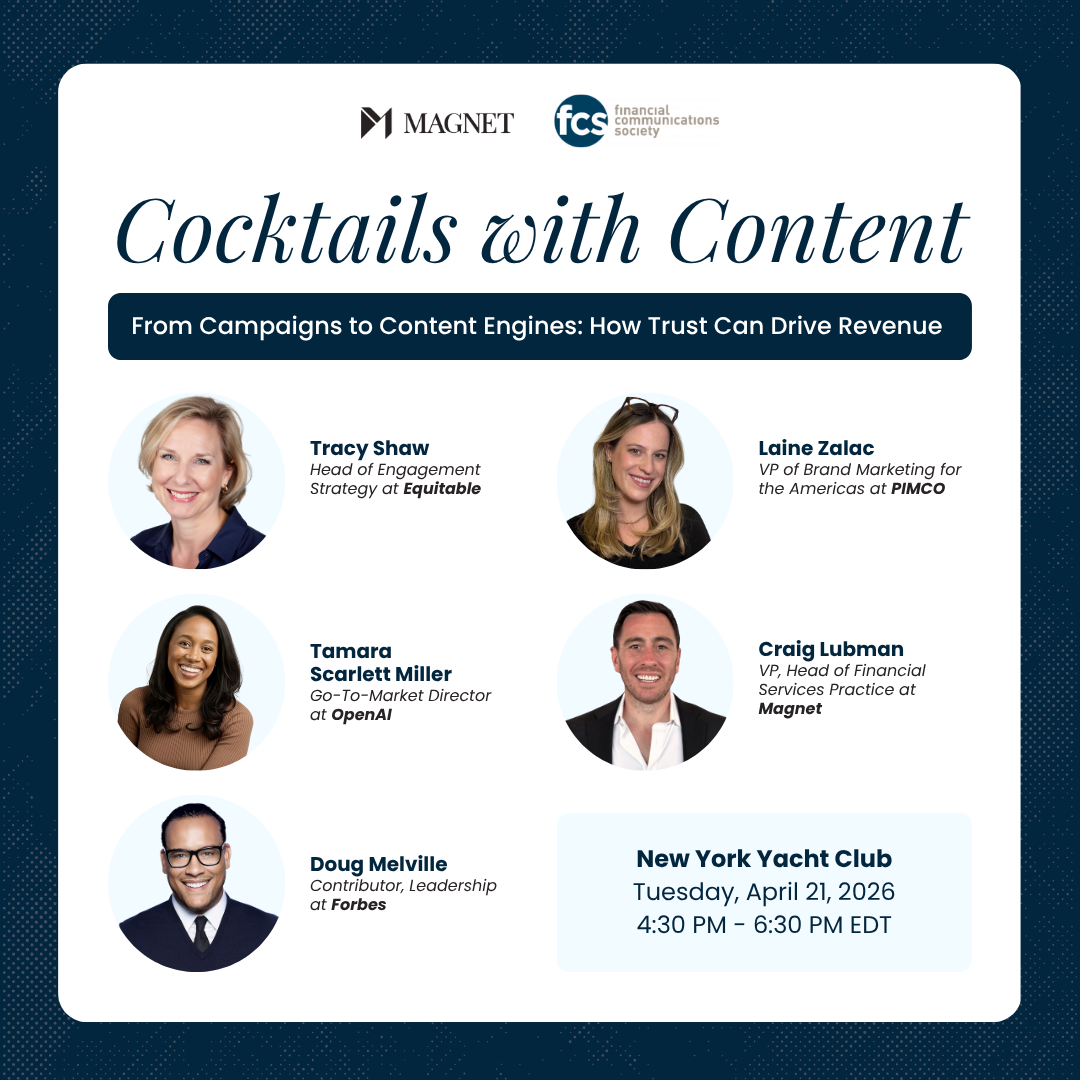
On April 21, the Financial Communications Society is hosting its next Cocktails with Content with Magnet at the New York Yacht Club
The panel picks up exactly where this post leaves off: four practitioners who have navigated these patterns in real regulated environments.
• Tracy Shaw, Head of Engagement Strategy, Equitable
• Laine Zalac, VP, Brand Marketing, PIMCO
• Tamara Scarlett, Member of the GTM Team, OpenAI
• Craig Lubman, VP, Head of Financial Services Practice, Magnet
Moderated by Doug Melville, Forbes contributor and author. Small room. High-caliber conversation. The kind of session where you leave with frameworks you can actually use.
Register for the April 21 FCS Event: Cocktails with Content
Take the Content Trust Audit here to see if you qualify for a complimentary guest pass.
New York Yacht Club | April 21, 2026 | 4:30–6:30 PM ET










We tell stories that matter
For over 20 years, Magnet’s mission has been to tell stories that matter so that we live in a more empathetic and just world. We intentionally pursue this mission by:
Having our teams and work represent the broader culture
Choosing projects that have positive societal impacts
Creating a community of thought sharing and leadership


Contact us
Let us know what you want to know!
